
Accepting an Invitation
Editors at SJOH select potential reviewers based on their expertise in research areas relevant to the manuscript under consideration. Reviewer invitations are sent by email from the journal. Use the links in the invitation email to accept or decline. Accept an invitation only if you have the knowledge, time, and objectivity required to provide an impartial assessment of the work. By agreeing to complete a review, you also give permission for your review to be published under a Creative Commons Attribution (CC BY) licence.
How We Conduct Peer Review
SJOH operates single-anonymised peer review by default, but gives both authors and reviewers the opportunity to participate in signed and openly published peer review.
Single-anonymised peer review
During the peer review process you will know the authors' names, but your identity will not be disclosed to them. Your review will appear in the editorial decision letter, where it can be read by the authors and other reviewers.
Signed peer review
You may choose to attach your name to your review when submitting it. If you sign your review, the authors and any other reviewers of the manuscript will see your name. If the authors choose to publish their peer review history, your name will accompany your comments alongside the published article.
Portable reviews
If the authors subsequently choose to transfer their manuscript to another journal, your review may accompany it. You may be contacted by editors at another journal to re-review the manuscript. Reviewers for any SJOH-affiliated journal should be willing to have their reviews considered by editors at another affiliated journal.
Published peer review history
If the authors opt to publish their peer review history, the editorial decision letter — including your review — will appear alongside the published article. Your name will not appear unless you chose to sign your review.
Reviewer Conduct and Responsibilities
Competing Interests
A competing interest is anything that interferes with, or could be perceived as potentially interfering with, the thorough and objective assessment of a manuscript. Common examples include:
- A recent or current collaboration with any of the authors
- Direct competition or a history of scientific conflict with any of the authors
- An opportunity to benefit financially from the work
Do not accept a review assignment if you have a competing interest, or if you do not feel able to provide an objective assessment. If you are unsure, contact sjoh@safesociety.org for advice. If asked to proceed regardless, declare the competing interest when submitting your review.
Co-reviewing
Co-reviewing is an excellent way to gain peer review experience under the supervision of an experienced reviewer. If you receive help completing the review, you must share your co-reviewer's name with the journal when submitting your review — either in the "Confidential Comments to Editor" section or by email. Do not include your co-reviewer's name in the body of the review itself. Competing interest and confidentiality policies apply to all reviewers.
Confidentiality
Keep all manuscripts and related correspondence confidential and do not share information about submissions with anyone other than the editor, unless previously agreed. Reviewers must not make use of any material or take advantage of any information gained through the peer review process.
Read the SJOH Confidentiality Policy.
Previously Reviewed Manuscripts
If you reviewed the article at another journal, treat the manuscript as a new submission unless instructed otherwise. It may have been revised since you last evaluated it, and SJOH's publication standards may differ from those of the other journal. When submitting your review, let the editor know that you previously reviewed a version of the manuscript at another journal.
Review Deadline
Aim to complete your review within 10 days. If you need more time, please contact us as soon as possible.
Recognising Your Contribution
By volunteering as a peer reviewer for SJOH, you are actively supporting free and open access to rigorous research — we are deeply grateful for your time and expertise.
ORCID Reviewer Credit
Link your SJOH reviewer account to your ORCID record and set up syncing so that reviewer activity is automatically recorded in your ORCID profile. This record will confirm that you completed a review for the journal, but will not disclose the content of your review.
Submitting Your Review in OJS
SJOH uses OJS (Open Journal Systems) as its submission and peer review platform. The review form contains two main sections:
Feedback for the Author
Responses to the questions in this section are required and will be included in the decision letter sent to the author. For questions 1–4, select a response from the dropdown (e.g., "Yes," "No," "I don't know," or "N/A") and provide any relevant details. Enter the main text of your peer review in the final question, "Review Comments to the Author."
Confidential Remarks for the Editor
Use this section to declare any potential or perceived competing interests. You will also have the option to list anyone who collaborated with you on the peer review, and to indicate whether you think the submission should be highlighted on the SJOH website if published. This information will play no role in the editorial decision-making process and will not be shared with the authors.
SJOH does not permit confidential comments other than the declaration of competing interests. If you have concerns relating to publication or research ethics, please contact us at sjoh@safesociety.org.
What to Evaluate
To be eligible for publication, manuscripts must satisfy our publication standards and comply with our editorial and publishing policies. The guidance below relates to articles reporting the results of original research.
Publication Standards
Unlike many journals that use peer review to assess whether an article reaches a threshold of "importance," SJOH uses peer review to determine whether a paper is technically rigorous and meets the scientific and ethical standards required for inclusion in the published scientific record.
Please review our seven publication standards carefully, as the criteria employed by SJOH differ quite substantially from those of many other journals. To be accepted, research articles must satisfy all of the following:
- The manuscript reports the results of original research.
- The findings reported have not been published elsewhere.
- Experiments, statistical analyses, and other analyses are conducted to a high technical standard and are described in sufficient detail.
- Conclusions are well-founded and properly supported by the data.
- The manuscript is clearly written and presented in standard English.
- The research satisfies all applicable ethical standards for experimentation and research integrity.
- The manuscript conforms to relevant reporting guidelines and community standards for data availability.
Registered Reports
Registered Reports are primary research articles in which the proposed methods and analyses are peer-reviewed before experiments, data collection, or analysis are conducted. Assessment takes place in two stages and, if accepted, results in two linked publications.
| Stage 1 — Registered Report Protocol | Stage 2 — Registered Report |
|---|---|
| You will review a manuscript reporting the study design, rationale, timeline, proposed methodology for data collection and analysis, and where applicable, ethical approval for the work. | You will review a manuscript reporting the methods and findings of the study originally described in the Registered Report Protocol. |
| Peer review aims to ensure that the proposed research is rigorous, the methodology and analysis are sound, and the resulting study will meet the publication standards. | Peer review focuses on adherence to the Registered Report Protocol and the appropriateness of any deviations. |
Consider:
|
Consider:
|
Lab Protocols
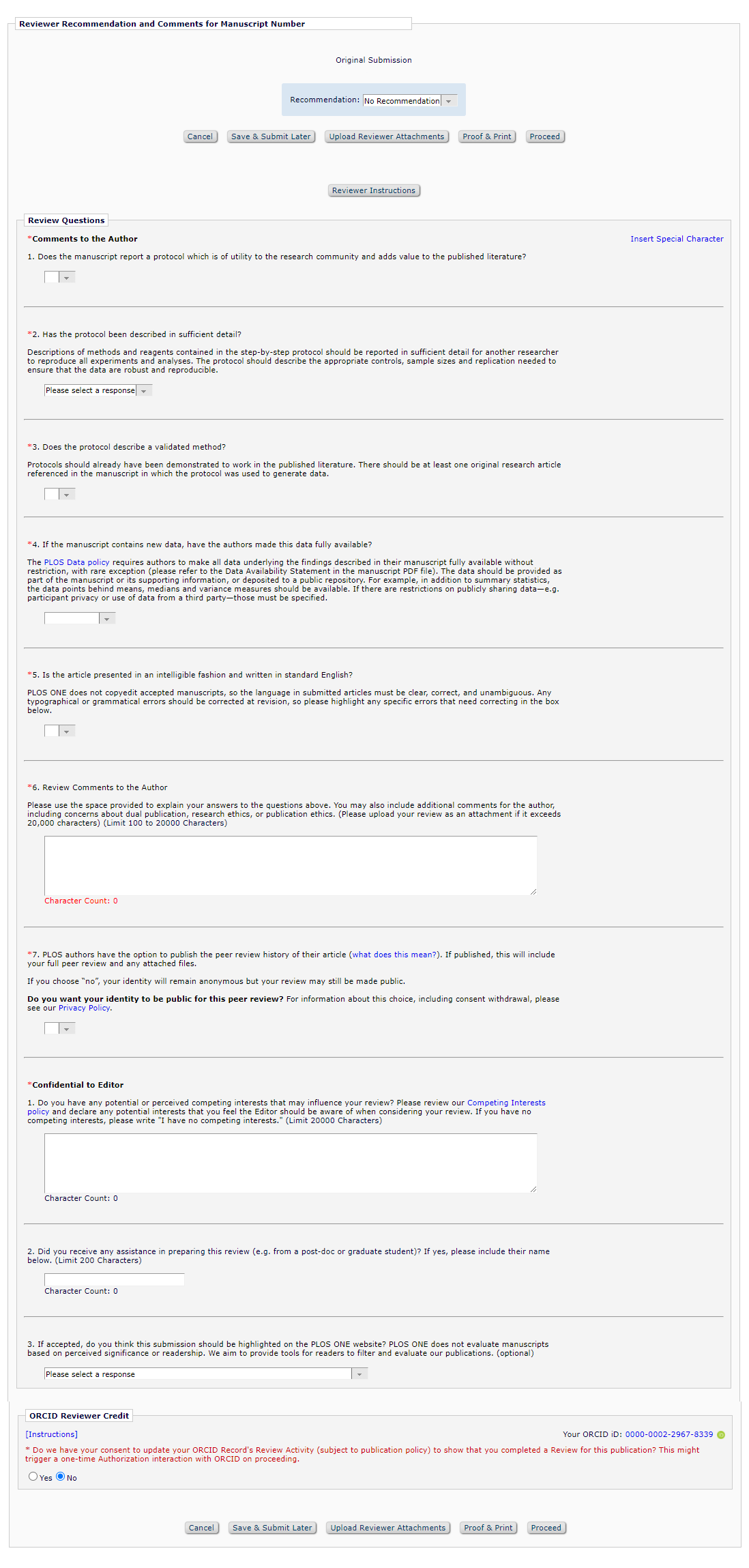
Lab Protocols present reusable methodologies for experimental and computational techniques. They typically consist of a protocol on the protocols.io platform together with an SJOH manuscript that contextualises it. The peer review process is generally expedited and usually carried out by one internal Academic Editor and one external reviewer.
You will review the manuscript while referring to the protocol on protocols.io or in PDF format as a Supporting Information file. Consider:
- Is the protocol of value to the research community?
- Does it link to a protocol on protocols.io, and is this attached in PDF format as a Supporting Information file?
- Are the methods and reagents described in sufficient detail?
- Are the controls and sample sizes appropriate?
- Do the authors demonstrate that the method is validated — either by linking to at least one supporting peer-reviewed publication, or by providing appropriate supporting data?
- If the manuscript contains new data, have the authors made these data fully available?
Study Protocols
Study Protocols present detailed plans and proposals for research projects that have not yet produced results. When assessing Study Protocols, the aim is not to evaluate the study design but rather to assess and comment on the study's ability to test the hypothesis, the sufficiency of detail for replication or comparison, the suitability of the planned statistical analysis, and the quality of the writing. Consider:
- Protocol prerequisites: the research study should not have generated results, and participant recruitment or data collection should not be complete.
- Are the required ethical standards met?
- Does the manuscript provide a valid rationale for the planned or ongoing study, with clearly identified and justified research questions?
- Is the protocol technically sound and planned in a manner that will lead to a meaningful outcome and allow testing of the stated hypotheses?
- Have the authors described where all data underlying the findings will be made available once the study is complete?
- Does the manuscript title contain the word "Protocol"?
- Is the methodology feasible and does the description provide sufficient methodological detail for the protocol to be reproduced and replicated?
- Are any recommended checklists provided as Supporting Information files?
- Have the authors registered the study on a research platform appropriate to the study type?
- For clinical trials: is the trial registered in one of the publicly accessible registries approved by the WHO or ICMJE, and has the registration number been provided? Has a completed SPIRIT checklist and schedule of enrolment been provided?
- For systematic reviews, scoping reviews, and meta-analyses: is the PRISMA-P checklist provided and complete? Have the authors opted to register with PROSPERO?
Writing Your Review
The purpose of the review is to provide the editors with an expert assessment of the validity and quality of the manuscript under consideration. The review should also supply the authors with constructive feedback on how to improve their work. As you write, consider the following points:
- What are the principal claims of the paper and how significant are they to the field?
- Are the claims appropriately situated in the context of the prior literature? Have the authors engaged with the existing literature fairly?
- Do the data and analyses fully support the claims? If not, what additional evidence is required?
- SJOH encourages authors to publish detailed protocols and algorithms as supporting information online. Do any particular methods used in the manuscript warrant such treatment?
- If the paper is currently unsuitable for publication, does the study itself show sufficient potential that the authors should be invited to submit a revised version?
- Are original data deposited in appropriate repositories, and are accession/version numbers provided for genes, proteins, mutants, diseases, etc.?
- Does the study conform to any relevant reporting guidelines such as CONSORT, MIAME, QUORUM, or STROBE?
- Is the level of methodological detail sufficient to allow the experiments to be reproduced?
- Is any software developed by the authors freely accessible?
- Is the manuscript well organised and written clearly enough to be accessible to non-specialists?
While confidential remarks addressed to the editors are respected, any comments that could help to strengthen the paper should be directed to the authors themselves.
Revisions
We frequently ask the original reviewers to assess revised manuscripts and the authors' responses to reviewer comments. We hope you will make yourself available for re-review and any follow-up questions from the editors.
The Editorial Process
How Decisions Are Made
The editors make the final decision on whether to publish each submission based on the reviewers' comments, the SJOH publication standards, and their own independent assessment of the manuscript.
Conflicting Reviews
If reviewers appear to disagree substantially, the editors may share all the reviews with each reviewer and request additional comments to help reach a decision. Decisions are not necessarily made according to a majority vote — experts may disagree, and it is the editor's responsibility to make a decision. Editors weigh reviewer recommendations and comments alongside comments by the authors and material that may not have been made available to reviewers. Please be aware that your recommendation has been carefully considered and your contribution is appreciated, even if the final decision does not align with your review.
Read more about the editorial assessment process.
Help
For further guidance on peer review, visit the SJOH Reviewer Centre and sign up to the Peer Review Toolbox.
If you have questions or concerns about the manuscript you are reviewing, or if you need assistance submitting your review, please email us at sjoh@safesociety.org.